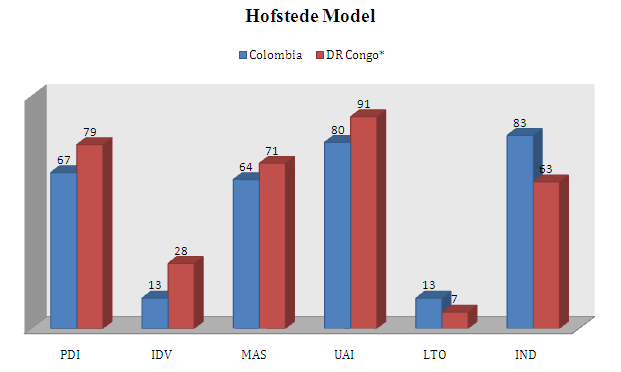
Now in this part, we can find comparison and contrast using the dimensions of Hofstede model, which can help to understanding the culture, between DR Congo and Colombia. The Hofstede model of national culture consists of six dimensions. The cultural dimensions represent independent preferences for one state of affairs over another that distinguish countries (rather than individuals) from each other (Geert Hofstede).
As we can see in the image, in general terms DR Congo and Colombia are alike in culture, at least in the dimensions measured by this model.
First, in terms of equality –Power Distance Index (PDI) – people in both countries accepted the social distance between the high and low ends of the society: power exists and is not generally challenged, these societies tend to be hierarchical, and people see it as normal. I think it is in this way because of the colonial history of them, DR Congo was a Belgian Colony and Colombia a Spain Colony, so the distance of power was rooted before his independence and still today they remain in the mindset of these people.
Different from I thought, both counties has a high score in Individualism Versus Collectivism index (IDV), it mean DR Congo has a collectivistic culture: Congolese people actually tend to have a strong sense of group identity, their focal or dominant group is family, clan or tribe, religion or religious subgroup and, in some aspects of life, national identity (Muhima, 2014). Likewise, the model considered Colombia as a collectivistic culture, I am disagree whit that because I live in this country, and I can see how the majority of the time people just worried about themselves, there are some proverbs which people often say about it: “marica el ultimo” and “el vivo vive del bobo”.
Talking about Uncertainly Avoidance Index (UAI), the Congolese and Colombian cultures have more of high-uncertainty-avoidance cultures since Congolese and Colombian people tend to be relatively rigid/conservative and less apt to promote innovative behavior. These cultures try to control the future. It is not very common for these people to get out of the box with unorthodox behavior and ideas. In the same way, both countries prioritize Short Term Orientation (LTO), it mean these societies prefer to maintain time-honoured traditions and norms while viewing societal change with suspicion, it could be because these people tend to expect relatively immediate results, they are somehow extravagant and save little, value leisure time over work, respect tradition and are not so concerned with change (Muhima, 2014).
Now, the most curious index for me is Masculinity Versus Femininity (MAS) which, for the case, show us how Colombia, just like, DR Congo, are societies highly success oriented, even being collectivistic cultures. From my point of view it is directly related to Distance Power: people, who accepted a hierarchical society, want to be part of the top, so they compete towards members of other groups for power.
Last but not less important, the Indulgence Versus Restraint index (IND) indicated Colombian people have a willingness to realize their impulses and desires, because in this country is ok to seek gratification and pleasure. Unlike Congolese people, who usually controlled their desires through social norms, which are highly respected.
REFERENCES

-Geert Hofstede. (n.d.). Hofstede Insights. Retrieved March 07, 2020, from https://hi.hofstede-insights.com/national-culture

-Muhima, S. (2014, July 31). Mon Journal RH. Retrieved March 07, 2020, from http://sergemuhima.over-blog.com/2014/07/what-should-international-hr-managers-know-about-the-congolese-culture.html

-Ntsomo Payanzo, B. M. (2020, February 28). Encyclopædia Britannica. Retrieved March 07, 2020, from https://www.britannica.com/place/Democratic-Republic-of-the-Congo

