I’m a girl who likes anime and write like if her life depends on it. Since I was a child, I write on the last page of my notebooks about the most strange and crazy dreams and nightmares. I liked invented histories about the origin and the feelings of the rare creatures such a kind of chimeras and I loved try to draw, but something was very difficult. I always had under my pillow my loyal pencil and my dear notebook of the previous class because I needed to write and draw the dream quickly when I woke up, and in this way didn’t forget details, because the details were the heart of my characters. The details help us to understand better the story.
Today I’m not a child, I have twenty years old and I’m studying accounting public on Universidad del Norte, but still draw and write something about interesting things which I would like to do a tale. My “me” of the past and my “actual me” still had something in common: for us, the details are the most important.
It is the reason why in this blog I will be talking about details, details to understand better the culture, in this case, the Congolese culture.
A subculture is set of values and beliefs of a group of people, whom have an specific identity and belong also to a bigger culture.
In this post you can find information about some subcultures in DR Congo. As examples I will be talking about the Sapeurs, the Kimbanguists and Bakongo tribe.
The Sapeurs first came onto the scene following the arrival of Europeans in the Congo around the 1920’s, where servants were able to observe their employers and were often given clothes second hand so that the employer would be able to show off their wealth by their ability to dress their servants well (Martin, p. 409). Modern sapeurs are highly admired within Congolese society in both Kinshasa and Brazaville. Sapeurism has become a cultural identity for these two cities. Different from 1920’s, today sapeurism is not just for men but is starting to expand to include women and children. Modern sapeurs are respectable, working class men and women who spend their hard-earned money on purchasing the best eye-catching clothing (Douniama, 2018). More than a fashion movement, it`s a social posture towards suffering of civil wars in DRC. They live an ordinary life but one obsessed with fashion for towards the idea of battling poverty through clothes, masking their economic reality with the illusion of wealth, and resisting the depravation they face.
The Kimbanguists
Church leaders are highly respected and idolized.
Kimbanguism (since 1921) is a religious movement professed by the Church of Jesus Christ on Earth by his special envoy Simon Kimbangu -called the black messiah- through his supposed miraculous healings and biblical teaching. Kimbangu was exiled until his death by Belgian authorities (the colonial regime in this moment) because this movement was considered a pan-African movement, thus not only religious but politically inclined. The militant style of dress and marching to the sound of music plays to the narrative of the movement having started and continued as a revolution.
Kimbanguists often attribute their belief in Kimbangu as the Holy Spirit and his sons are the three persons of the Holy Trinity, because of the testimonies about miracles he performed and the rereading of biblical passages. However, they have also often been quoted as saying, “because it is said in our hymns, which are not works of art, but inspiration from above.” Three significant beliefs Kimbanguists hold are:
Jesus est noir (Jesus is black)
Il est Africain (He is African)
Il est Ne Le 25 Mai (He was born on May 25th) (Waiswa, 2018).
The Bakongo Tribe
Kongo people in a traditional ceremony
They are generally known as the Kongo people. They lived along the Atlantic Coast of Africa. The Bakongo were one of the first African people to use Christianity as a tribe. They believe that a spirit called “Nzambe” made the universe “Nzambe” lives above a world of ancestor spirits. The Bakongo religion centers on ancestor and spirit cults, which also play a part in social and political organization. Kongo people believed when you die you’ll go to a village of ancestors and the ancestors will watch over your family. They usually are considered to be very proper dressers by other Congolese.
References

- Douniama, V. (2018, June 25). Culture Trip. Retrieved March 12, 2020, from https://theculturetrip.com/africa/congo/articles/the-art-of-la-sape-fashion-tips-from-congos-sapeurs/

- Martin, P. M. (1994). Contesting Clothes in Colonial Brazzaville. In Journal of African History (pp. 401-426). Cambridge: Cambridge Universitv Press.

- Waiswa, S. (2018, October 18). Witnes. Retrieved March 12, 2020, from https://witness.worldpressphoto.org/kimbanguists-the-people-of-simon-cb0e2cb238fe

- Guide, Africa. “Bakongo People.” N.p., n.d. Web. 29 Sept. 2016
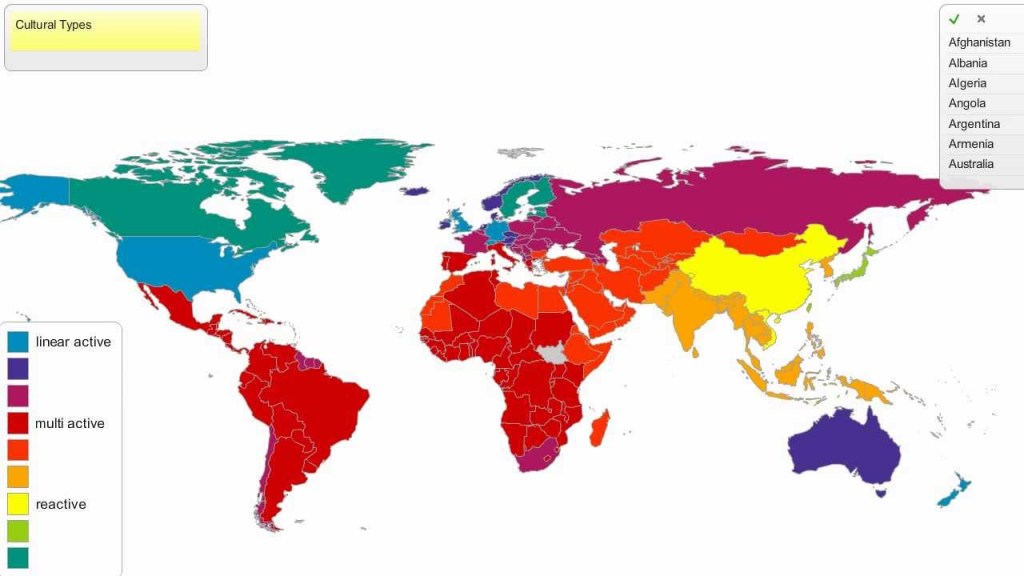
In this section I will be talking about how is categorized Congolese culture through The Lewis Model. This categorized countries in three cultures: Linear-Active (task-oriented), Multi-Active (people-oriented), and Reactive (respect-oriented listener). This model it is very useful in business, but we can use to understand better a culture and has an idea about what characteristics they have.
When I read about this model, the first to come to my mind was “Congolese people look like happy people so Congolese people is a Multi-active Culture” and I was right, but not exactly because of those reasons. Right now, after read a lot of information about this country, I can explain you the real reasons why DR Congo belong to this culture.
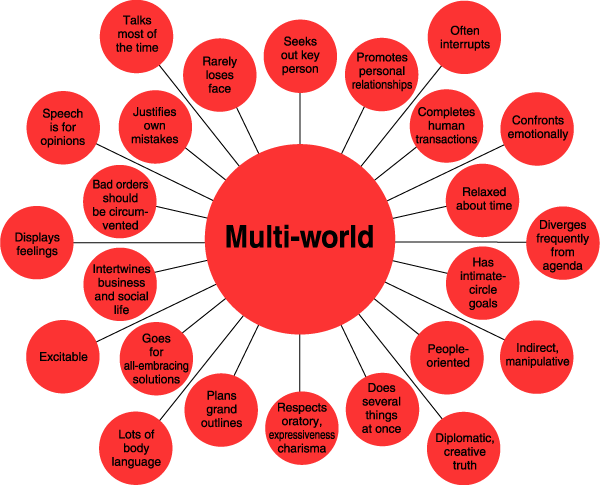
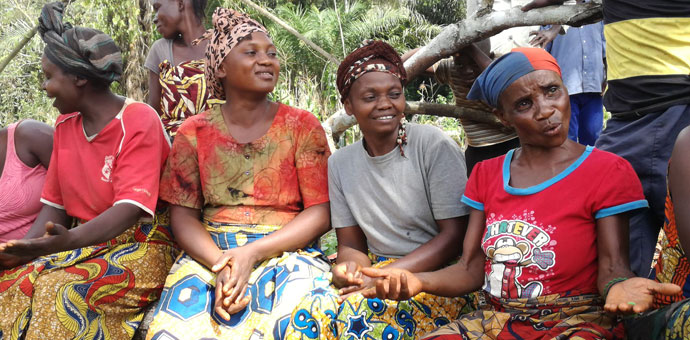
First of all, what are Multi-Active Cultures? They are cultures which people are talkative, impulsive types who attach great importance to feelings, relationships and people-orientation: Congolese people tend to be very lively and engaged, and women as well as men ask many questions in a conversation. They like to do many things at the same time and they do not like agendas or strict schedules because they feel confined, they like to be more spontaneous. A Congolese conversation is animated, usually Congolese people display striking optimism and a strong determination, and they try to speak and listen at the same time. Interruptions are frequent and pauses in conversation are few because they feel uncomfortable with silence.
Characteristics of a Multi-Active Culture like DR
The foundations of Congolese Culture as a Multi-Active Culture are related with their values and the importance of collectivism, the traditional forms of social and economic solidarity instead the individuality. Defending the interests of the community is a duty for all, including children. Congolese people remain a resilient, fun-loving bunch with high regard for culture and traditions. They uphold their identity and heritage may often call a distant family member (or even someone not related by blood) their son, daughter, brother, or sister (Resettlement agency staff, 2014).
Congolese people are very expressived, they use a lot of the body language.
Now, imagine a Congolese student who comes to Barranquilla-Colombia, do you think he or she will has big troubles because of the differences between those cultures? Based on Lewis Model don`t, it turns out that Colombia is too a Multi-Active Culture. Likely, in a study meeting, both Congolese and Colombian are late, one of them eating his/her lunch and the other one in a call talking about a presentation unfinished. Both of them will want to talk the majority of time, impatient to talk again instead listen, confronted emotionally whit lot of body language, and displayed feelings. They will be extremely dialogue-oriented and will wish to obtain their information directly. Also, our two friends could have many characteristics in common: extroverts, leaders, loquacious, multi-tasks, emotional people, excitable people, diplomatic people, and not organized people.
To summarize, The Lewis Model show us characteristics of people according to the culture which the country belongs. It helps us to understand better the culture of a country. For the case, DR Congo is categorized as a Multi-Active Culture: people-oriented. Colombia is too. It is the reason why we can to say the interaction between people from these countries could be easier than people different cultures according to The Lewis Model.
References

-Resettlement agency staff, s. p. (2014, January). Refugees from the Democratic Republic of the Congo. 12. (Z. C. Sanja Bebic, Interviewer, & D. A. Ranard, Editor) United States of America: Cultural Orientation Resource Center.

-Richard LewisCommunications. (n.d.). CrossCulture. Retrieved March 11, 2020, from know culture for better business: https://www.crossculture.com/about-us/the-model/multi-active/
*One should clarify, DRC doesn`t appear in the official bases of Hofstede model, so the next information about this country from articles, blogs, statistics and more. Remember is just an approximation.
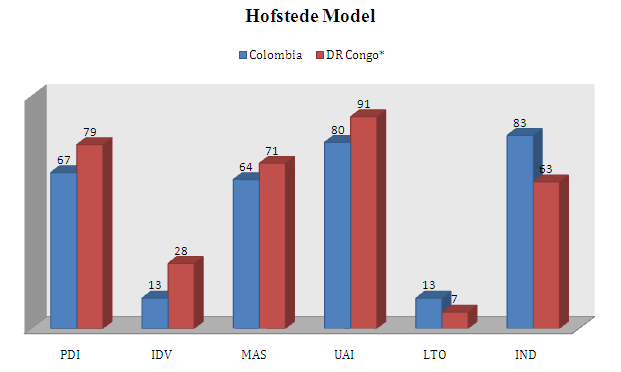
Now in this part, we can find comparison and contrast using the dimensions of Hofstede model, which can help to understanding the culture, between DR Congo and Colombia. The Hofstede model of national culture consists of six dimensions. The cultural dimensions represent independent preferences for one state of affairs over another that distinguish countries (rather than individuals) from each other (Geert Hofstede).
As we can see in the image, in general terms DR Congo and Colombia are alike in culture, at least in the dimensions measured by this model.
First, in terms of equality –Power Distance Index (PDI) – people in both countries accepted the social distance between the high and low ends of the society: power exists and is not generally challenged, these societies tend to be hierarchical, and people see it as normal. I think it is in this way because of the colonial history of them, DR Congo was a Belgian Colony and Colombia a Spain Colony, so the distance of power was rooted before his independence and still today they remain in the mindset of these people.
Different from I thought, both counties has a high score in Individualism Versus Collectivism index (IDV), it mean DR Congo has a collectivistic culture: Congolese people actually tend to have a strong sense of group identity, their focal or dominant group is family, clan or tribe, religion or religious subgroup and, in some aspects of life, national identity (Muhima, 2014). Likewise, the model considered Colombia as a collectivistic culture, I am disagree whit that because I live in this country, and I can see how the majority of the time people just worried about themselves, there are some proverbs which people often say about it: “marica el ultimo” and “el vivo vive del bobo”.
Talking about Uncertainly Avoidance Index (UAI), the Congolese and Colombian cultures have more of high-uncertainty-avoidance cultures since Congolese and Colombian people tend to be relatively rigid/conservative and less apt to promote innovative behavior. These cultures try to control the future. It is not very common for these people to get out of the box with unorthodox behavior and ideas. In the same way, both countries prioritize Short Term Orientation (LTO), it mean these societies prefer to maintain time-honoured traditions and norms while viewing societal change with suspicion, it could be because these people tend to expect relatively immediate results, they are somehow extravagant and save little, value leisure time over work, respect tradition and are not so concerned with change (Muhima, 2014).
Now, the most curious index for me is Masculinity Versus Femininity (MAS) which, for the case, show us how Colombia, just like, DR Congo, are societies highly success oriented, even being collectivistic cultures. From my point of view it is directly related to Distance Power: people, who accepted a hierarchical society, want to be part of the top, so they compete towards members of other groups for power.
Last but not less important, the Indulgence Versus Restraint index (IND) indicated Colombian people have a willingness to realize their impulses and desires, because in this country is ok to seek gratification and pleasure. Unlike Congolese people, who usually controlled their desires through social norms, which are highly respected.
REFERENCES

-Geert Hofstede. (n.d.). Hofstede Insights. Retrieved March 07, 2020, from https://hi.hofstede-insights.com/national-culture

-Muhima, S. (2014, July 31). Mon Journal RH. Retrieved March 07, 2020, from http://sergemuhima.over-blog.com/2014/07/what-should-international-hr-managers-know-about-the-congolese-culture.html

-Ntsomo Payanzo, B. M. (2020, February 28). Encyclopædia Britannica. Retrieved March 07, 2020, from https://www.britannica.com/place/Democratic-Republic-of-the-Congo
Well, I’m from Colombia, and in this part of my blog I would like to do a contrast between my country and DR Congo, in particular about gender roles.
These days, gender roles in Colombia have changed, we can say in a better way. There are less traditional gender roles and there are also more modern gender roles. I mean, in a general view, people had changed their mindsets, however, still we can see people, majority on the rural areas who believe that women have to care the children and keep a clear house, be nice with her husband –because some people believe that the women’s life objective is married with a man who can protect her as physical as economical- and have pretty children, that`s it. In the same way, in RD Congo, but this mindset is expanded and is most common (obviously there are people who can’t believe that): man providing for family and woman take care of children. But is also important mentioned since the mid-1990s, there has been an increase in the number of women becoming wage earners in the DRC to help bring in extra income for the family (Weijs, Hilhorst & Ferf, 2012).
In Colombia, woman have acquired more recognized that years ago. Now, women had the same rights that men, and it’s a big progress, here the women’s independence it’s acceptable for community. Too different from DR Congo, where women’s legal rights are limited, with married women unable to open a bank account, obtain a passport, or rent or sell property without their husbands’ permission.
The promotion of women’s human rights and gender equality is not seen as a priority such as Colombia as DR Congo. But in DR Congo, violence against women seems to be perceived by large sectors of society to be normal while in Colombia it’s a minority. In DR Congo, 74.8% of women agreed that a husband is justified in beating his wife in certain circumstances (The 2013–2014 DHS survey (pp. 299)). Mass rapes, sexual violence and sexual slavery are used as a weapon of war by the Armed Forces of the Democratic Republic of the Congo. The eastern part of the country in particular has been described as the «rape capital of the world». It doesn’t mean Colombia is a paradise to be woman, women in Colombia are often abused and even raped and it doesn’t get reported or if it does, sometimes there are no punishments for the abuser.
Also, women in Colombia usually are describe like beautiful, and yeah, you can think oh it’s wonderful, but…not all, the problem is that in Colombia there are a big stereotype of beauty, and many times it’s directly related to sexuality, the woman who is “buena”, so, some men believed that scream it at the girl while she is walking on the street it’s a good idea, and he is on all his right. While in DR Congo, physical strength and feelings comes first and external beauty second.
To conclude, if well is true DR Congo had more deep troubles- majority accepted- about gender roles, both countries had gender roles problems and is necessary for us, don’t approve or justified these can of behavior on any way which related woman as the weak sex.
Bibliography
-Bart Weijs, D. H. (2012). Livehoods, basic servicesprotection in Democratic Republic of the Congo. Wageningen: Wageningen university.
The children on my draw is wearing a father`s t- shirt, too big for his little size, he is barefoot playing with stones, but it doesn’t happy, he has a empty glace because he feel so hungry and in this moment he would like the stones will be breads.
When I think in DR Congo, come to my mind words like suffering, poverty, malnutrition, gender violence, resources mismanagement because of corruption. In the other hand, I can think on a beautiful river, beautiful landscapes and a lot of diversity.
Now, when I think on Congolese people, I imagine black people wear old clothes, dirty, barefoot, and hungry.
In my draw, there are many stereotypes, first, Congolese people are poor, they had hunger the majority of time because they don’t have food. Second, Congolese people is unhappy, even children have a empty glace. I think these stereotypes come from massive media, the news on the newspaper about the conflicts on DR Congo, the generalization about surveys or index, in general the lack of information search by me about the real aspects of the culture.
Well, let me say you, culture is not just it. It is just the upper of the iceberg, but the actually important is behind, the things we can`t see inmediatly.
Culture is all you thing, but culture is also beliefs, values, ideals. social norms and taboos, behaviours in a society, with family and friends, assumptions, notions, expectations, rules, attitudes, notions, perceptions….culture is all.